Watoria Guide
Kuru Toga vs Orenz vs DelGuard: Best Japanese Mechanical Pencil for Your Writing Style
Kuru Toga, Orenz and DelGuard solve different mechanical-pencil problems. Compare lead rotation, ultra-fine writing, break protection, lead sizes, drawbacks and the type of writer each system suits.

- Quick Answer
- What You’ll Learn
- The three pencils solve three different problems
- Kuru Toga: best fit for consistent everyday lines
- Orenz: best fit for tiny writing and precise annotation
- DelGuard: best fit for strong writing pressure
- At-a-glance comparison by reader job
- How to choose lead size before choosing the body
- Authenticity, compatibility and buying checks
- Care and failure points to know
- FAQ
- Related Guides
- Official References
- Final Thoughts
- Keep exploring Japanese culture
- Continue to the best buying / booking route
- Continue exploring
- Discover more Japan
- Primary sources
- Useful guides
Quick Answer
Choose Kuru Toga if you want a consistently sharp point and even line width, Orenz if your priority is very fine 0.2 or 0.3 mm writing with the lead protected by a sliding sleeve, and DelGuard if you press hard and mainly want to reduce lead breakage. There is no single winner for every writer because the three systems solve different problems.
What You’ll Learn
- How the Kuru Toga rotating-lead mechanism changes line consistency.
- Why Orenz can use ultra-fine lead with the protective pipe touching the paper.
- How DelGuard reacts differently to vertical and angled writing pressure.
- Which lead diameter and mechanism fit notes, dense annotation, exams and everyday writing.
- The practical drawbacks, compatibility checks and care habits that matter before buying.
The three pencils solve three different problems
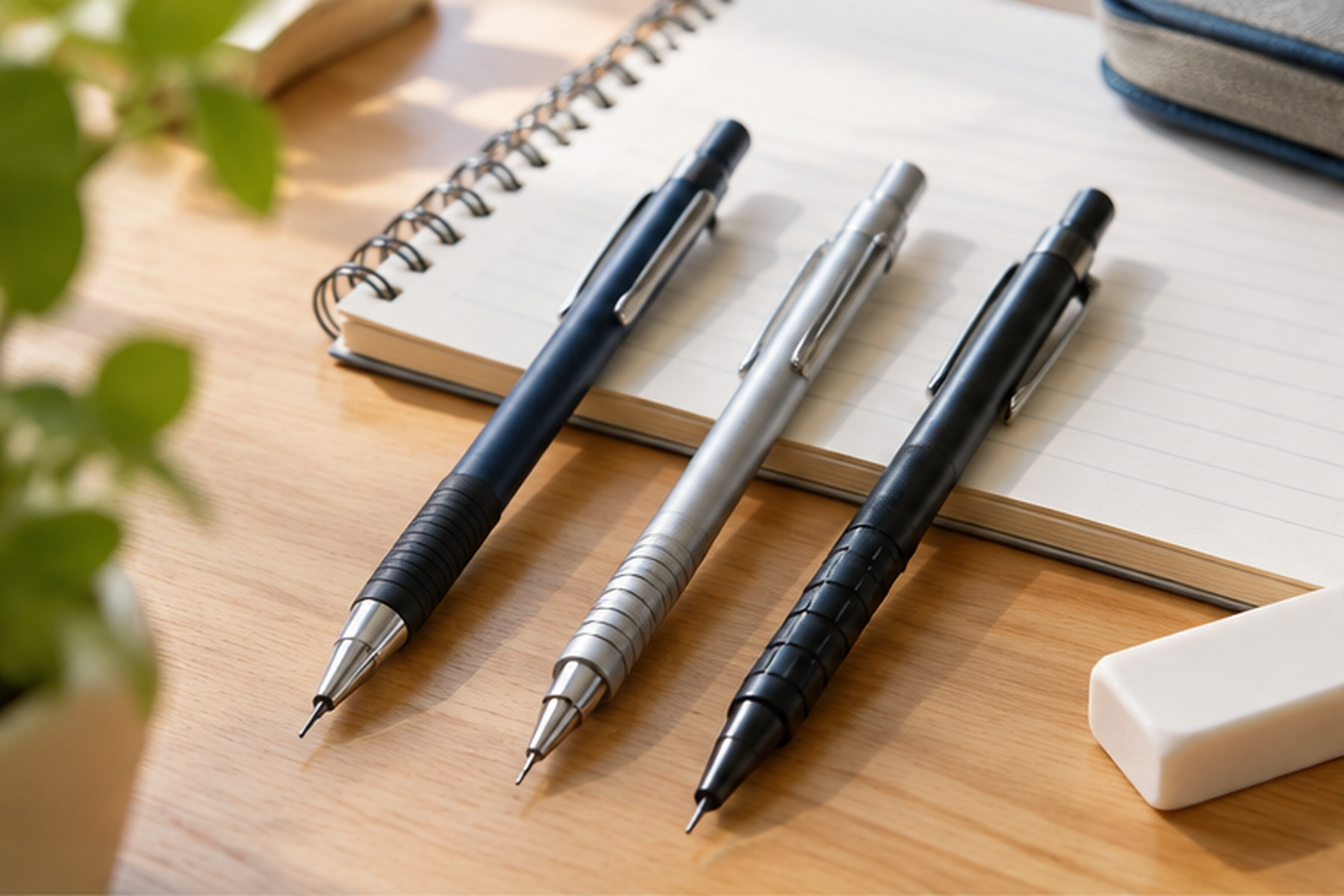
Kuru Toga from Mitsubishi Pencil, Orenz from Pentel and DelGuard from Zebra are often grouped together because each adds a mechanical system around an ordinary graphite lead. The important difference is what each system is trying to control.
Kuru Toga is about keeping the lead wear more even. Orenz is about protecting a very fine lead behind a sliding pipe. DelGuard is about responding to sudden writing pressure before the exposed lead snaps. That makes the most useful comparison a writing-style comparison rather than a simple brand ranking.
- Kuru Toga: line consistency and point maintenance.
- Orenz: ultra-fine writing with minimal exposed lead.
- DelGuard: protection for writers who use stronger pressure.
Kuru Toga: best fit for consistent everyday lines
The Kuru Toga engine rotates the lead a small amount as writing pressure is detected across repeated strokes. Mitsubishi Pencil explains that this evens out the lead wear instead of allowing one flat face to develop on the graphite. In normal note-taking, that can make the line feel more consistent from stroke to stroke.
The mechanism is most noticeable for writers who repeatedly lift and place the pencil while forming letters or characters. Mitsubishi Pencil also notes that extremely light pressure, very little movement, or a shallow writing angle can reduce how consistently the rotation engages. If you draw long continuous lines or deliberately shade with one side of the lead, the rotating behavior may be less useful than it is for ordinary writing.
The Kuru Toga family includes multiple body styles, so weight, grip and tip feel vary by model. Treat the rotating-lead system as the common reason to choose the family, then choose the specific body separately.
- Good for class notes, office notes and writers who dislike a widening chisel-shaped lead tip.
- Especially sensible in 0.5 mm for a familiar everyday lead size.
- Less compelling if you write with extremely low pressure, keep the pencil at a very shallow angle, or mainly sketch broad shading.
Orenz: best fit for tiny writing and precise annotation
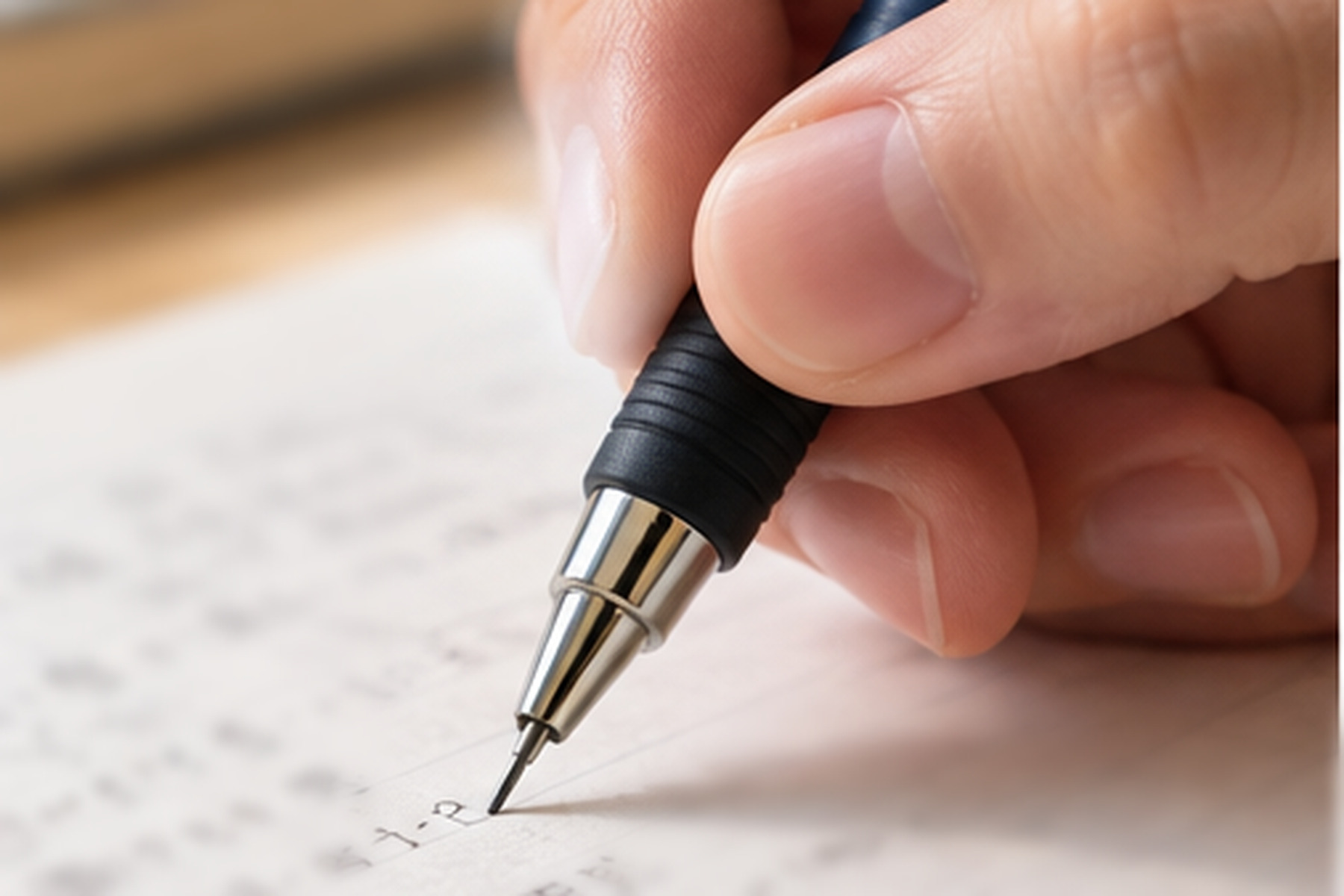
Orenz protects the graphite by letting the metal pipe sit against the paper while the lead remains largely inside it. As the graphite wears, the pipe slides back. Pentel describes this as the core Orenz system and offers Orenz models in 0.2, 0.3 and 0.5 mm, with some higher-end variants also adding automatic lead advance.
The practical advantage is clearest at 0.2 and 0.3 mm. Very small handwriting, textbook annotation, technical notes and compact planners can benefit from the narrow line. The trade-off is that the pipe is part of the writing experience. Some writers notice more contact between metal and paper than they would with a conventional exposed lead.
Pentel also warns that heavy pressure can leave marks because the pipe touches the paper, and that using Orenz against a ruler can lift the protective pipe and expose the lead, making breakage more likely. That makes Orenz a precision tool rather than the obvious choice for every drafting habit.
- 0.2 mm: for exceptionally dense notes and very small annotations.
- 0.3 mm: a more forgiving precision choice for compact handwriting.
- 0.5 mm: keeps the Orenz sleeve concept while using a more common lead diameter.

DelGuard: best fit for strong writing pressure
DelGuard uses a two-direction protection system. Zebra states that strong vertical pressure causes an internal spring to let the lead move upward, while strong angled pressure makes a metal part at the tip extend around the lead. The two actions are intended to reduce breakage from the forces that commonly snap exposed graphite.
The standard DelGuard is offered in 0.3, 0.5 and 0.7 mm, and the family also includes variants with different grips, balance and eraser designs. For most buyers, the core reason to choose DelGuard is simple: you tend to press hard, write quickly, or get distracted by frequent broken lead.
The protection is not unlimited. Zebra notes that extending too much lead can still cause breakage, and some colored or very soft leads fall outside the conditions for which the protection is intended. Use the correct diameter and keep only a sensible amount of lead exposed.
- Good for exam practice, fast note-taking and writers with firm pressure.
- 0.5 mm is the easiest all-purpose starting point.
- 0.7 mm suits people who prefer a bolder line and a thicker lead, while 0.3 mm favors finer writing.

At-a-glance comparison by reader job
The mechanisms are easier to choose when you start with the problem you actually experience while writing. The same person can reasonably prefer different pencils for different tasks.
- For consistent line width in ordinary notes: Kuru Toga is the most directly targeted system.
- For the smallest practical handwriting: Orenz 0.2 or 0.3 mm offers the clearest advantage.
- For repeated lead breakage from strong pressure: DelGuard is the most directly targeted system.
- For rulers and straightedge work: avoid assuming Orenz is automatically ideal; Pentel specifically warns about ruler use with the sliding pipe.
- For soft or colored leads: verify the exact DelGuard compatibility guidance before relying on its break-protection claims.
- For a conventional 0.5 mm workflow: all three families have viable choices, so grip, weight and mechanism preference become decisive.
How to choose lead size before choosing the body
Lead diameter changes the experience almost as much as the mechanism. A 0.2 or 0.3 mm point can fit more information into a small space, but it rewards lighter pressure and careful handling. A 0.5 mm lead is the safest general-purpose choice because it balances line precision, availability and robustness. A 0.7 mm lead gives a broader, stronger line and is useful for people who dislike fragile fine lead.
Do not buy a pencil first and decide the lead size later. The diameter is fixed by the mechanism. Confirm the model code and lead diameter on the manufacturer page or packaging, then buy matching refill lead. If you are importing a Japan-market model, check that replacement erasers and any model-specific parts are available where you live.
- Choose 0.2 mm only when dense writing is a genuine need.
- Choose 0.3 mm for fine notes with a little more margin for error.
- Choose 0.5 mm for the broadest everyday compatibility.
- Choose 0.7 mm when you want a stronger, darker-feeling line and the model family offers it.
Authenticity, compatibility and buying checks
These product families have many versions, limited colors and region-specific listings. Before buying, match the exact manufacturer, model name, model code and lead diameter rather than relying on a marketplace title alone. Compare the listing photos with the current manufacturer page and be cautious when a seller combines several different versions into one generic description.
For overseas buyers, the simplest authenticity check is consistency: the body design, package markings, lead diameter and model code should agree with the official reference. A low price by itself does not prove a fake, and a high price does not prove authenticity. If the model is difficult to source outside Japan, a proxy or forwarding route may be useful, but shipping, fees, customs and return practicality should be checked before purchase.
- Match model code and lead diameter to the official maker page.
- Do not assume all Kuru Toga, Orenz or DelGuard bodies have the same weight, grip or features.
- Use refill lead of the correct diameter and follow model-specific guidance for hardness when stated.
- Check return terms before importing a model with a more complex tip mechanism.
Care and failure points to know
Mechanical pencils with moving tip systems reward basic care. Avoid forcing bent or damaged lead through the front. Keep the tip protected in a case. Do not overfill the lead reservoir. If a jam occurs, use the maker’s cleaning instructions rather than pushing improvised metal objects into the mechanism.
Orenz in particular has a small sliding pipe and model-specific jam-clearing instructions. Kuru Toga depends on free movement in the rotating mechanism. DelGuard depends on its pressure-response parts moving correctly. A pencil that suddenly feels rough, stops advancing lead, or no longer behaves as expected should be cleared and checked before more force is applied.
- Carry the pencil with the tip retracted or protected when the design allows it.
- Load only a small number of matching leads rather than packing the reservoir full.
- Remove short broken fragments when the manufacturer instructions call for it.
- Do not treat a jam as a reason to keep clicking harder.
FAQ
- Which is better for students, Kuru Toga, Orenz or DelGuard?
- For general class notes, Kuru Toga 0.5 mm is attractive if you value a consistent point. Orenz is stronger for very small annotations, while DelGuard is a better fit if you regularly break lead by pressing hard. The right choice depends on the writing problem you actually have.
- Does Kuru Toga rotate the lead while drawing one continuous line?
- The mechanism relies on repeated writing pressure and contact changes. Mitsubishi Pencil notes that extremely light pressure, minimal movement and shallow writing angles can reduce rotation, so it is more naturally suited to ordinary writing strokes than to every kind of continuous drawing.
- Is 0.2 mm Orenz too fragile for everyday use?
- The Orenz system is specifically designed to protect fine lead with a sliding pipe, but 0.2 mm still demands more careful use than a thicker lead. If you want fine writing with less fuss, 0.3 mm is a sensible middle ground.
- Can DelGuard still break lead?
- Yes. Its mechanism is designed to reduce breakage, not make breakage impossible in every condition. Zebra warns that too much exposed lead, certain soft leads and colored leads can fall outside the conditions where the system works as intended.
- Which of the three is easiest to buy and refill overseas?
- That varies by country and exact model. Standard 0.5 mm refill lead is generally the easiest format to replace, but model-specific erasers, tip parts and premium variants can be harder to source. Check local availability before choosing a specialized version.
Official References
Final Thoughts
Kuru Toga, Orenz and DelGuard are strong examples of Japanese stationery design because each turns a small writing frustration into a mechanical design problem. Pick Kuru Toga for consistent point wear, Orenz for protected ultra-fine writing, or DelGuard for pressure-related breakage. Then choose the specific body, grip and lead diameter that fit your hand rather than assuming the most expensive variant is automatically the best match.