Watoria Guide
Best Japanese Notebooks and Paper for Fountain Pens
Compare Japanese notebooks and paper for fountain pens by feathering, bleed-through, show-through, writing feel, paper weight and binding, with practical guidance for overseas buyers.
- Quick Answer
- What You’ll Learn
- Best-Fit Summary: Four Japanese Paper Styles at a Glance
- How to Choose Fountain-Pen Paper Before You Buy
- MD Notebook: The Balanced Everyday Choice
- APICA Premium C.D.: For Writers Who Prefer a Silkier Page
- Tomoe River S: Thin Paper for Maximum Page Density
- LIFE Noble: Traditional Construction and Smooth L Writing Paper
- Comparison Criteria That Matter More Than Brand Hype
- Compatibility, Authenticity and Care
- Buying Route for Overseas Readers
- FAQ
- Related Guides
- Official References
- Final Thoughts
- Keep exploring Japanese culture
- Continue to the best buying / booking route
- Continue exploring
- Discover more Japan
- Primary sources
Quick Answer
The best Japanese fountain-pen paper depends on what you value most. If you are choosing the pen first, our Pilot vs Platinum vs Sailor guide compares the three major Japanese fountain-pen brands for first-time buyers. MD Notebook is the safest all-round starting point if you want controlled feathering, low bleed-through and a little tactile feedback. APICA Premium C.D. suits writers who prefer a silkier, smoother page and a sewn notebook that opens easily. Tomoe River S is the specialist choice when you want very thin paper and many pages without a bulky book; Sanzen specifically designs it for good writing performance with fountain pens. LIFE Noble is a strong traditional notebook option for readers who like smooth cream paper and durable section-sewn construction. Do not choose by brand name or gsm alone: your nib width, ink flow, ink formula, writing pressure and tolerance for show-through all change the result.
What You’ll Learn
- How MD Paper, APICA Premium C.D., Tomoe River S and LIFE Noble differ in writing feel and construction.
- Why feathering, bleed-through, show-through and dry time are separate things when evaluating fountain-pen paper.
- How nib width, ink wetness, page color, ruling and binding affect the best notebook choice.
- Which paper type is the better fit for everyday notes, journaling, ink-heavy writing or high page counts.
- What overseas buyers should verify about exact paper generation, format, seller description and shipping before ordering.
Best-Fit Summary: Four Japanese Paper Styles at a Glance
Japanese stationery has an unusually broad range of papers that work well with fountain pens, but they are not interchangeable. A useful comparison starts with the writing experience you want rather than with a universal ranking. Some writers prefer a page that feels almost glassy under the nib; others want a little feedback so the pen feels controlled. Some care most about keeping a notebook compact, while others would rather use heavier paper if it reduces how much writing is visible from the reverse side.
MD Paper is the most balanced option in this group. The maker explicitly designs the paper around ink behavior, feathering, drying, smoothness and tactile feel, and its cream version is described as ideal for fountain pens. APICA Premium C.D. takes a smoother route with its A.Silky 865 Premium writing paper and a sewn binding designed to open easily. Tomoe River S goes in the opposite direction on thickness: Sanzen makes 52 g/m² and 68 g/m² versions of this very thin diary paper and states that it has good fountain-pen writing suitability with reduced feathering and soak-through. LIFE Noble uses the company's own L Writing Paper and emphasizes smooth writing plus durable split-fold binding.
None of those descriptions means every ink-and-nib combination will behave identically. A broad, wet nib can put far more liquid on the page than a dry extra-fine nib. Treat the manufacturer specifications as a shortlist, then match the paper to your actual writing habits.
- Balanced everyday choice: MD Notebook with standard MD Paper.
- Very smooth notebook feel: APICA Premium C.D.
- Thin paper and high page density: notebooks or loose paper that explicitly use Tomoe River S.
- Traditional cream-paper notebook feel with sturdy binding: LIFE Noble.
How to Choose Fountain-Pen Paper Before You Buy
Start by separating four performance questions. Feathering is when ink spreads sideways into paper fibers and makes letter edges look fuzzy. Bleed-through is when ink penetrates to the reverse side strongly enough to mark or spot it. Show-through, sometimes called ghosting, is simply the visibility of writing from the other side without actual ink penetration. Dry time is how long the ink remains vulnerable to smearing on the surface. A paper can perform well in one area and still be less convenient in another.
Next, match the notebook to the pen you use most often. Extra-fine and fine nibs usually place less ink on the page, while broader or wetter nibs make paper behavior more obvious. Highly saturated or slow-drying inks may also need more patience. If you rotate many inks, a conservative all-round paper is easier to live with than choosing a notebook around one spectacular ink sample.
Finally, decide how much paper color and surface feedback matter to you. Cream paper can make long writing sessions feel softer to the eye and can change how some ink colors appear. Bright white paper gives a different visual contrast. A smoother sheet can feel luxurious with a polished nib, while a lightly textured sheet can give useful control. These are preference questions, not quality grades.
- Compare feathering, bleed-through, show-through and dry time separately.
- Use your wettest everyday nib-and-ink combination as the stress test.
- Choose white or cream paper partly by how you want inks to look.
- Check whether you prefer a glassy glide or a little tactile feedback.
- Consider binding and page count before focusing on paper weight alone.
MD Notebook: The Balanced Everyday Choice
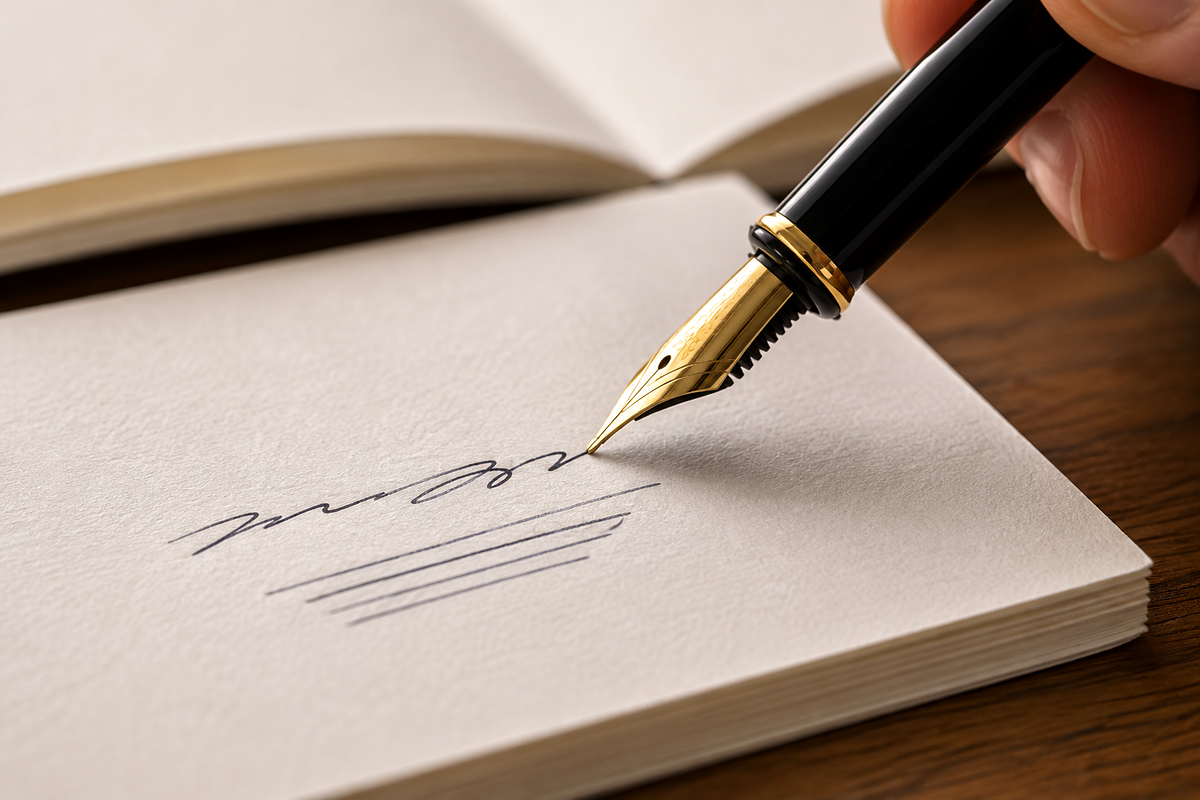
MD Paper is one of the clearest starting points because the manufacturer publishes unusually specific information about how the paper is designed. MIDORI says its original paper is developed around ink behavior, including feathering and drying, and describes both white and cream MD Paper as resistant to smearing and bleed-through. The current MD PRODUCT information also states that standard MD Paper resists feathering and bleed-through even with fountain pens.
The standard MD Notebook uses 80 g/m² MD Paper and thread-stitched binding that opens flat to 180 degrees. That combination is useful for journaling, meeting notes and long-form writing because you can write comfortably near the center fold without forcing the book open. The standard surface is not trying to eliminate all tactile feedback; the maker describes a balance of smoothness and slight resistance.
For a first fountain-pen notebook, this balance is often more useful than chasing the thinnest or slickest paper. If you already know that you prefer very soft, low-feedback writing, APICA may be more appealing. If your priority is fitting hundreds of pages into a compact book, Tomoe River S is the more specialized direction.
- Standard MD Paper: 80 g/m² in the current MD Notebook lineup.
- Thread-stitched notebooks open flat to 180 degrees.
- Manufacturer explicitly discusses fountain-pen feathering and bleed-through resistance.
- Available paper experiences include standard MD Paper and MD Paper Cotton; verify the exact notebook variant.
APICA Premium C.D.: For Writers Who Prefer a Silkier Page
APICA's Premium C.D. Notebook is built around the idea that paper should be chosen as deliberately as a pen. The manufacturer's current product documentation highlights two writing-paper experiences in the range, including the original A.Silky 865 Premium paper and APICA Cream Woodfree Paper in selected A5 variants.
The same official documentation specifies Smyth sewn binding, chosen because it opens flat for easier writing. That matters with fountain pens: a notebook that stays open reduces the tendency to twist your wrist or press harder near the gutter. The A.Silky option is the one to shortlist when your priority is a smooth, low-friction writing sensation.
Do not assume that every notebook carrying the broader C.D. name uses exactly the same premium paper. Check that the listing actually says Premium C.D. Notebook and identifies the paper or product code you intend to buy. Overseas listings sometimes shorten names or mix photos from similar products.
- Best fit when smoothness is a higher priority than tactile feedback.
- Official documentation highlights A.Silky 865 Premium writing paper.
- Smyth sewn binding is designed to open flat.
- Confirm the exact Premium C.D. variant rather than relying on a generic C.D. product title.
Tomoe River S: Thin Paper for Maximum Page Density
Tomoe River S is different from the other choices because it is fundamentally a paper platform used in diaries, notebooks and memo products rather than one single notebook design. Sanzen states that Tomoe River S is based on thin India paper and is specially designed for writing. The company lists 52 g/m² and 68 g/m² specifications and says the paper has good suitability for fountain pens with reduced feathering and soak-through.
Sanzen began manufacturing the current Tomoe River S at its Kanazawa factory in February 2022 after succeeding the Tomoe River diary-paper line. That history matters when shopping online because older listings may use the Tomoe River name without making the generation clear. If you specifically want the current Sanzen paper, look for an explicit reference to Tomoe River S rather than assuming every old review or listing describes the same paper.
The main practical advantage is density: very thin paper allows a notebook to carry many pages without becoming proportionally thick or heavy. The tradeoff is that thin paper naturally makes reverse-side visibility more noticeable for some writers, even when there is no true bleed-through. If show-through bothers you more than notebook bulk, a heavier paper may be more comfortable.
- Current Sanzen Tomoe River S specifications include 52 g/m² and 68 g/m².
- Designed for diary, planner and memo applications.
- Manufacturer specifically states good fountain-pen writing suitability.
- Verify that a seller is describing Tomoe River S, not an older or unspecified Tomoe River generation.
LIFE Noble: Traditional Construction and Smooth L Writing Paper
LIFE Noble is the traditional-feeling option in this group. LIFE describes the Noble Note as one of its signature products, made carefully by craftspeople in Tokyo's downtown area. The company uses its original L Writing Paper for the text block and emphasizes a smooth writing experience.
The notebook also uses split-fold binding to improve durability for long-term use. That construction makes sense for writers who want a substantial notebook rather than a disposable pad. LIFE offers Noble formats across multiple sizes and rulings, so it can serve as a journal, project notebook or desk notebook rather than only a fountain-pen test book.
LIFE's own product page focuses on smooth writing and construction rather than publishing the same fountain-pen-specific performance language used by MD or Sanzen. For that reason, buyers using especially wet nibs or unusual inks should still test a page before committing an important notebook to a new combination.
- Uses LIFE's original L Writing Paper.
- Split-fold binding is intended to improve long-term durability.
- Multiple sizes and ruling styles are available.
- Good candidate for writers who want a classic cream-paper notebook experience.
Comparison Criteria That Matter More Than Brand Hype
Paper weight is useful, but it is not a complete quality score. A lighter sheet can resist feathering and bleed-through because of how it is formulated and finished, while a heavier sheet can still behave poorly with a wet fountain pen. Use gsm mainly to understand thickness, page count and likely show-through rather than as a shortcut for fountain-pen compatibility.
Binding is just as important in everyday use. Thread-sewn or section-sewn notebooks that open flat reduce the physical effort of writing across a spread. Loose sheets and pads are better if you scan, file or rearrange pages. A planner with hundreds of thin pages may be ideal for daily records but unnecessary if you mostly write short meeting notes.
Ruling also changes how useful a paper feels. Plain paper shows ink and handwriting without visual interference. Grid layouts are practical for mixed writing, diagrams and structured notes. Ruled pages support longer prose. The best choice is the one that makes you use the notebook more consistently, not the one with the most famous paper name.
- Do not use gsm as a fountain-pen quality ranking.
- Check lay-flat behavior and gutter comfort.
- Choose notebook, pad, loose leaf or diary format by workflow.
- Match plain, grid or ruled layouts to how you actually write.
- Consider page color, show-through tolerance and dry-time habits together.
Compatibility, Authenticity and Care
Fountain-pen compatibility is a system, not a property of paper alone. The same notebook can look clean with a fine nib and show much more feathering or slow drying with a broad, wet nib. Before starting a long journal, use the last page or a discreet corner to test your wettest pen and the inks you intend to use.
Store unused notebooks in a dry place away from prolonged direct sunlight and high humidity. Paper can distort if it repeatedly absorbs moisture, and covers or bindings can age differently from the text block. If you use very slow-drying ink, a sheet of blotting paper can reduce accidental transfer when closing the notebook.
For authenticity, rely on exact maker and paper names, product codes when available, and a seller description that matches the manufacturer's specifications. This matters especially with Tomoe River, where generation names are meaningful, and with product families such as APICA C.D., where the Premium line should not be assumed from a similar-looking cover. If a listing is vague about the paper, ask before ordering rather than guessing from photographs.
- Test your wettest pen and ink before committing many pages.
- Use blotting paper if your inks dry slowly.
- Keep notebooks dry and out of prolonged direct sunlight.
- Verify exact product names and paper generation in overseas listings.
- Treat seller photos as supporting evidence, not a substitute for specifications.
Buying Route for Overseas Readers
The safest buying route is to start with the manufacturer's product page, note the exact product name, size, ruling and paper type, then compare reputable stationery retailers that ship to your country. This reduces the risk of ordering a similarly named notebook with a different paper or binding.
Check shipping weight and package dimensions before placing a large order. Paper is dense, and several A4 or B5 notebooks can become expensive to ship even if individual books look inexpensive. For Tomoe River S products, also check whether the seller identifies the paper manufacturer or current S specification rather than using the Tomoe River name generically.
If you are still learning your preferences, buy one notebook or a small pad first. Use the same pens and inks you already own, record what you notice about feathering, show-through, drying and writing feel, and only then scale up. That small trial is more reliable than building a large order around someone else's nib, ink and handwriting style.
- Start from the official specification, then compare sellers.
- Confirm size, ruling, paper type and binding before ordering.
- Factor international shipping weight into large notebook orders.
- Buy one test notebook first if you do not yet know your paper preference.
- Keep purchase and shipping questions separate from writing-performance claims.
FAQ
- What is the best Japanese notebook for a fountain-pen beginner?
- MD Notebook is the most straightforward starting point because the maker explicitly designs MD Paper around fountain-pen ink behavior and publishes clear information about feathering, bleed-through and writing feel. If you strongly prefer a slicker surface, APICA Premium C.D. is a good alternative.
- Is Tomoe River S better than 80 gsm paper for fountain pens?
- Not automatically. Tomoe River S is much thinner and is specifically designed for good fountain-pen writing performance, but its main advantage is fitting many pages into a compact book. If visible show-through bothers you, a heavier paper may suit you better even if both resist actual bleed-through.
- Does higher gsm always mean less fountain-pen bleed-through?
- No. Paper formulation, surface treatment and ink absorption matter as much as weight. Use gsm to understand thickness and page density, then rely on maker specifications and your own nib-and-ink test for writing performance.
- Why does the same notebook behave differently with different inks?
- Fountain pens vary in nib width and ink flow, and inks vary in saturation, lubrication and drying behavior. A wet broad nib can put much more liquid on the page than a dry fine nib, so feathering, drying and show-through can change even on the same sheet.
- What should I check when buying Tomoe River notebooks online?
- Look for an explicit statement that the product uses Tomoe River S and check the listed paper weight if provided. Sanzen identifies Tomoe River S as its current diary paper produced at the Kanazawa factory from 2022, so vague listings that only say Tomoe River may not tell you enough about the paper generation.
Official References
Final Thoughts
There is no single Japanese paper that wins every fountain-pen comparison. MD Paper is the balanced starting point, APICA Premium C.D. emphasizes smoothness, Tomoe River S minimizes bulk while preserving fountain-pen writing suitability, and LIFE Noble offers a durable traditional notebook built around smooth L Writing Paper. Choose the paper behavior and notebook format that fit your nibs, inks and tolerance for show-through, then test one book before buying in quantity.