Watoria Guide
Japanese Rice Cookers: What Overseas Buyers Need to Know About Voltage
A practical guide to Japanese rice-cooker voltage, frequency, plug compatibility and overseas-use risks, with a safer way to choose a model for your country.
- Quick Answer
- What You’ll Learn
- Why Voltage Matters More Than the Plug Shape
- Japan's 100V System and the 50/60Hz Divide
- Domestic Japanese Models and Export Models Are Not the Same Product
- What a Plug Adapter Can and Cannot Do
- Should You Use a Step-Down Transformer?
- How to Check a Rice Cooker Before Buying
- What Overseas Buyers Should Avoid
- FAQ
- Related Guides
- Official References
- Before You Buy: Three Real-World Scenarios
- Final Thoughts
- Keep exploring Japanese culture
- Continue to the best buying / booking route
- Continue exploring
- Discover more Japan
- Primary sources
Quick Answer
Do not assume a rice cooker bought for the Japanese domestic market can be used safely overseas just because the plug fits or an adapter is available. Japan generally uses 100V, with 50Hz in eastern regions and 60Hz in western regions. Many Japan-market rice cookers are rated 100V, while manufacturers also sell region-specific 120V, 220–230V or 240V models. Match the appliance's rated voltage and frequency to your local supply and follow the manufacturer's instructions; a plug adapter changes plug shape, not the appliance's electrical rating.
Check the 120V Zojirushi option
Confirm the NS-ZCC10 voltage, plug, warranty and delivery terms for your location before buying. If Amazon cannot serve your location, use the Japan proxy-shopping fallback.
View on AmazonWhat You’ll Learn
- Why Japan-market rice cookers are commonly rated for 100V
- How voltage, frequency and plug shape are three different compatibility checks
- Why a plug adapter is not the same thing as a voltage solution
- How to identify region-specific rice cooker models before buying
- What to verify about warranty, servicing and replacement parts for overseas use
Why Voltage Matters More Than the Plug Shape
For overseas buyers, the most important number on a rice cooker is not the plug style but the rated voltage printed on the appliance or specified by the manufacturer. Japan's household electrical supply is generally 100V. The country's frequency is split geographically: 50Hz in eastern Japan and 60Hz in western Japan. That means a domestic Japanese appliance may be designed around electrical conditions that differ from those in North America, Europe, Australia and many parts of Asia.
A physical plug adapter only changes the connector shape so a plug can fit a different socket. It does not by itself convert 120V, 220V, 230V or 240V mains electricity to 100V. Because rice cookers are heat-producing appliances with substantial power draw, voltage mismatch is not a detail to treat casually.
- Check rated voltage first.
- Check rated frequency second.
- Check plug and grounding arrangement third.
- Confirm the manufacturer's country-of-use guidance before connecting power.
Japan's 100V System and the 50/60Hz Divide
Japan is unusual among major consumer markets because its standard household voltage is generally 100V. Kansai Transmission and Distribution explains that eastern Japan uses 50Hz while western Japan uses 60Hz, with the boundary running through parts of Shizuoka and Niigata. Panasonic's international electrical-conditions chart likewise lists Japan at 100V and 50/60Hz.
Many modern Japanese rice cookers are marked 50–60Hz, which means frequency itself may not be the limiting factor. The bigger problem for an overseas buyer is often voltage: a 100V Japan-market cooker is not automatically compatible with 120V or 220–240V supplies. Always judge the exact model, not the brand name or product family.
Domestic Japanese Models and Export Models Are Not the Same Product
Major Japanese manufacturers sell different electrical versions of rice cookers for different markets. Tiger, for example, lists Japan-market JRX-T models at 100V and 50–60Hz. Its U.S. JPW-G models are listed at 120V and 60Hz, while Australian JPW-G models are listed at 240V and 50–60Hz. This is exactly why an overseas buyer should not assume that a familiar model name or Japanese brand guarantees universal compatibility.
The safest buying route is to choose a version officially specified for the voltage in the country where it will be used. That can preserve not only electrical compatibility but also the manufacturer's intended warranty and service framework.
- Japan-market example: 100V models exist.
- North American versions may be 120V/60Hz.
- European, Asian or Australian-market versions may be 220–240V depending on the model and destination.
- Use the exact model number to verify specifications.
What a Plug Adapter Can and Cannot Do
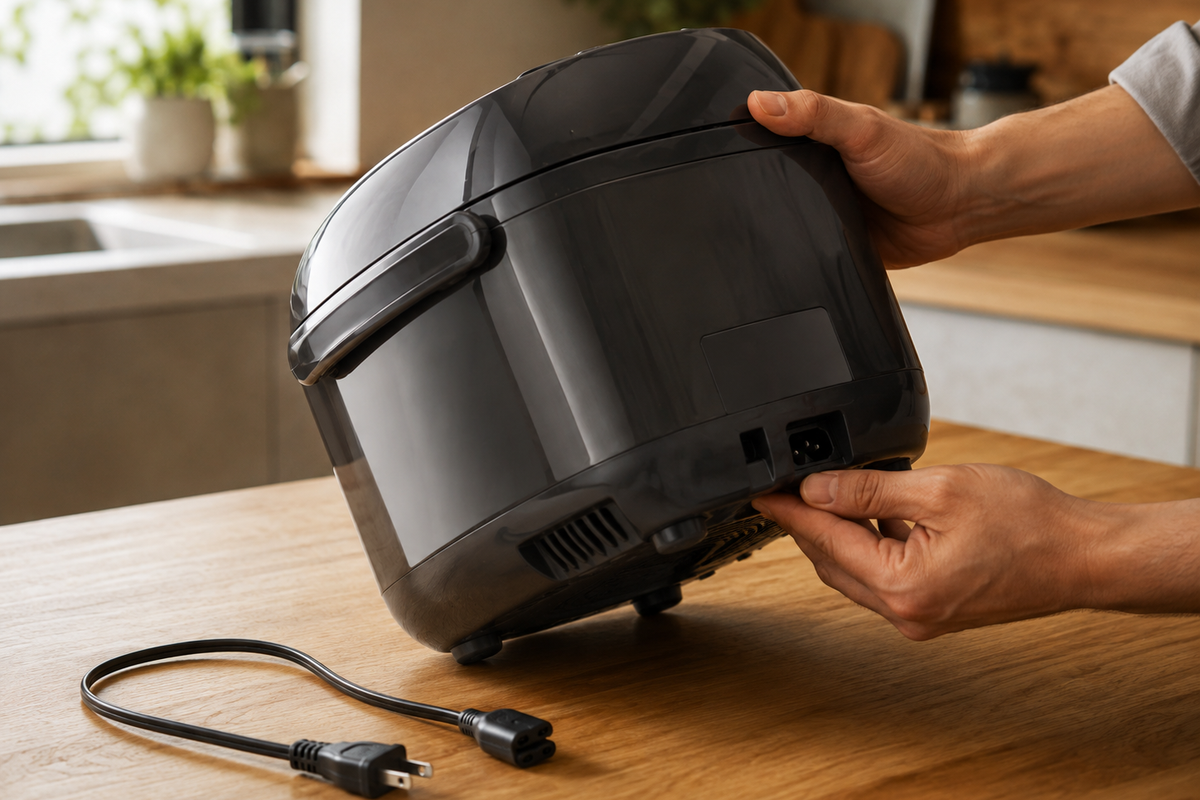
A plug adapter can be useful when the appliance's electrical rating already matches the local supply but the physical plug shape differs. It should not be treated as a voltage converter. A buyer who sees a Japanese two-pin plug that physically fits a North American socket may still be dealing with a 100V appliance on a nominal 120V supply.
Manufacturer guidance matters here. Zojirushi's North American rice-cooker FAQ says its U.S./Canada products are manufactured for use in those markets and that use overseas with voltage converters or plug adapters is not recommended; it also notes that repair, parts and warranty support remain limited to the U.S. and Canada for those products. This illustrates a broader point: electrical compatibility and after-sales support must be checked together.
Should You Use a Step-Down Transformer?
A properly specified step-down transformer can change voltage, but that does not automatically make every rice cooker an approved or sensible overseas setup. Rice cookers can draw substantial wattage, especially induction-heating and pressure models, and some manufacturers do not recommend using their appliances outside the intended market even with a converter.
If you are considering a transformer, first check the rice cooker's rated wattage, startup and heating behavior, grounding requirements, frequency rating, and the transformer's continuous power capacity. More importantly, check the appliance manufacturer's instructions. If the maker offers an official model for your local voltage, that version is normally the cleaner choice than building a permanent high-power converter setup around a domestic 100V unit.
- Do not size a transformer by plug shape alone.
- Do not assume a small travel converter is appropriate for a high-wattage heating appliance.
- Check whether the manufacturer permits converter use.
- Prefer an official local-voltage model when one is available.
How to Check a Rice Cooker Before Buying
Before ordering a Japanese rice cooker for overseas use, treat the model number as the primary source of truth. Product photos and seller descriptions can be incomplete, and a visually identical cooker may exist in several electrical versions. Cross-check the exact model against the manufacturer's official specification page or manual.
Also consider practical ownership details. A model intended for another country may use different replacement parts, power cords, inner pots or service channels. Warranty coverage can be geographically restricted. These issues matter more over several years of ownership than a small difference in features at the time of purchase.
- Exact model number
- Rated voltage
- Rated frequency
- Rated wattage
- Plug and grounding type
- Official destination market
- Warranty and service region
- Availability of replacement parts and inner pots
What Overseas Buyers Should Avoid
Avoid listings that describe a cooker simply as 'Japanese' or 'Japan version' without showing the exact electrical specifications. Avoid assuming that '50/60Hz' means universal voltage; frequency compatibility does not turn a 100V appliance into a 230V appliance. Avoid choosing a transformer before you know the cooker's rated wattage and the manufacturer's policy.
The goal is not to avoid Japanese rice cookers. Japanese manufacturers make excellent region-specific models for many markets. The goal is to buy the version engineered for the electrical system where you will actually use it.
FAQ
- Can I use a 100V Japanese rice cooker on 120V in the United States?
- Do not assume so. A 100V Japan-market model is outside its stated voltage when connected directly to a nominal 120V supply. Check the exact model's manufacturer instructions and look for a 120V version intended for the U.S. or Canada where available.
- Does a plug adapter convert voltage?
- No. A plug adapter changes the physical connector shape. It does not by itself change 120V, 220V, 230V or 240V supply voltage to the voltage required by the rice cooker.
- Is 50Hz versus 60Hz important for rice cookers?
- It can be. Many current Japanese models are rated 50–60Hz, but you must verify the exact model. Voltage and frequency are separate specifications, and both should match the manufacturer's requirements.
- Can I use a step-down transformer with a Japanese rice cooker?
- Possibly in some technical setups, but do not treat it as an automatic solution. Rice cookers can be high-wattage appliances, and manufacturer policies may discourage converter use. Verify wattage, frequency, grounding, transformer capacity and the maker's instructions first.
- What is the easiest way to buy a Japanese rice cooker for overseas use?
- Choose an official region-specific model whose rated voltage and frequency match your local electrical supply. This also tends to simplify warranty, service and replacement-parts support.
Official References
Before You Buy: Three Real-World Scenarios
You live in North America: do not assume a Japan-market 100V cooker is equivalent to a 120V model. If the maker sells a North American version, that is usually the lower-risk choice because the electrical rating, plug, warranty and support are designed for the market where you will use it.
You live in Europe or Australia: a plug adapter is not enough for a 100V Japan-market cooker. Look for an official 220–240V export model or a model sold for your region. A voltage transformer adds cost, bulk and another failure point, so it should not be treated as the default solution.
You are buying from a Japan-only shop: verify the exact model number on the manufacturer’s specification page before paying. Check rated voltage, frequency, power consumption, grounding, warranty region and whether replacement inner pots or parts are available internationally.
Watoria’s practical rule: electrical compatibility comes before cooking features. If two models are similar, choose the one officially intended for your local power system.
If a Japan-only seller does not ship to your country, a proxy service such as Remambo can be one route to purchase and international forwarding. Compare current service fees, shipping cost, warranty limits and total landed cost before ordering.
Final Thoughts
For an overseas buyer, the best Japanese rice cooker is not simply the model with the most advanced cooking modes. It is the model whose electrical specification, plug and grounding arrangement, warranty and service network all fit the country where it will live. Verify the exact model number against official manufacturer specifications before purchase, and prefer an official local-voltage version whenever one is available.