Watoria Guide
Best Japanese Santoku Knives Under $150
A practical shortlist of Japanese santoku knives that fit a 0 item-price ceiling, with current maker pricing, steel, handle, blade size, care and overseas-buying trade-offs.
- Quick Answer
- What You’ll Learn
- How this under-0 shortlist was defined
- Five santoku knives worth comparing
- MAC Superior SK-65: the light, straightforward pick
- TOJIRO BASIC F-316 vs TOJIRO PRO F-895
- Shun Sora VB0718: the longer hollow-ground option
- MIYABI KOH 4000FC 6-inch: the premium compact choice
- Choose by blade length, handle and steel—not by the word Japanese
- Overseas buyers should budget for landed cost and seller verification
- Care and sharpening determine whether a bargain stays a bargain
- FAQ
- Related Guides
- Official References
- Final Thoughts
- Keep exploring Japanese culture
- Continue to the best buying / booking route
- Continue exploring
- Useful guides
- Discover more Japan
- Primary sources
Quick Answer
If you want a light, no-drama first santoku, the MAC Superior SK-65 is a strong fit at a current direct price of $90. For maximum value, TOJIRO BASIC F-316 gives you a 170 mm VG10 blade and pakkawood handle at an official Japan price of ¥6,600. TOJIRO PRO F-895 costs more but adds an all-stainless handle and the same practical 170 mm size. Shun Sora VB0718 gives you a longer hollow-ground profile and composite construction, while the MIYABI KOH 4000FC 6-inch is the premium compact option near the top of the budget at a current U.S. list price of $134.99. Treat $150 as the knife price before tax, shipping, import charges or proxy fees, and recheck the live listing because price and stock can move.
What You’ll Learn
- Which current Japanese santoku models fit below a $150 item-price ceiling
- How blade length, steel, weight and handle design change the feel of a santoku
- Which models make sense for beginners, small kitchens and heavier daily prep
- Why a low knife price can still become expensive after shipping, tax or proxy fees
- How to care for and sharpen a santoku so the purchase keeps its value
How this under-0 shortlist was defined
The budget line in this guide is the knife's listed item price before sales tax, international shipping, import charges, engraving, accessories or proxy fees. That distinction matters because a knife can qualify at the product level and still land above $150 at your door.
The shortlist favors current santoku models from identifiable Japanese makers with clear blade length, steel or construction details, handle information and care guidance. Prices are taken from maker-direct or current retailer listings available during this check. Japanese official-store prices are left in yen rather than converted so the article does not pretend an exchange rate is fixed.
This is not a permanent ranking. A sale can move one knife below the threshold and a price change can move it above. Use the model comparison to decide what fits your hand and kitchen, then verify the exact live price, seller, stock and destination eligibility before ordering.
- Budget test: item price below $150 before tax and shipping
- Priority: clear maker, exact model, blade and handle specifications
- Preference: stainless or stainless-clad general-purpose santoku models
- Final check: live seller, stock, shipping, returns and destination restrictions
Five santoku knives worth comparing
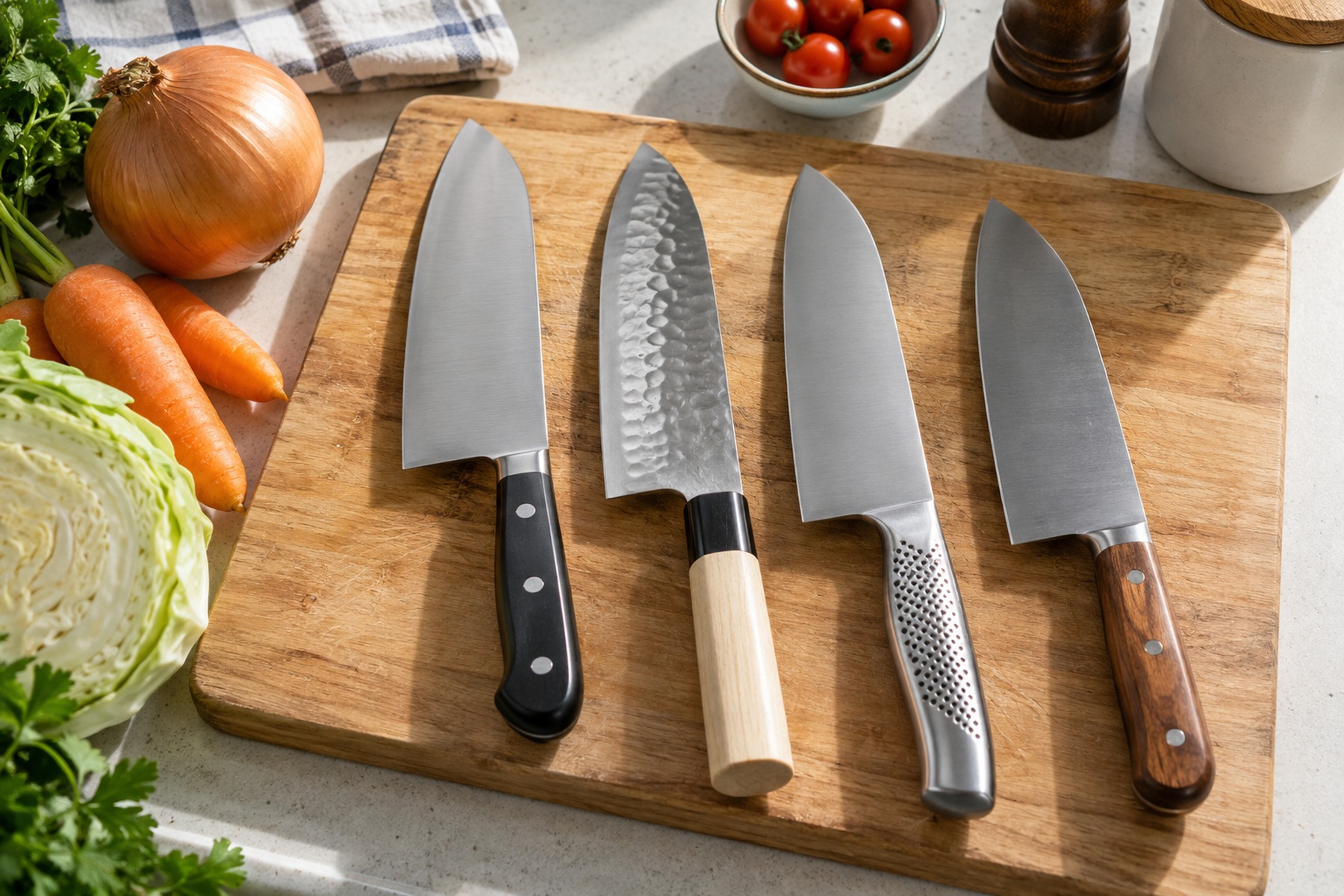
The five options below cover different reasons to buy rather than five versions of the same idea. MAC is the light, easy-handling choice. TOJIRO BASIC is the value VG10 choice. TOJIRO PRO trades a little more weight for an all-stainless handle. Shun Sora gives you a longer, hollow-ground blade with composite construction. MIYABI KOH sits near the budget ceiling with a compact blade, harder FC61 steel and an octagonal pakkawood handle.
Do not over-read the price order. A 170 mm knife may suit a small board better than a longer one even if it is cheaper, while a heavier or harder knife is not automatically better. The useful question is which compromise matches your normal ingredients, grip and maintenance habits.
- MAC Superior SK-65 — $90 direct; 6.75-inch blade; 5.4 oz; thin 2.0 mm profile
- TOJIRO BASIC F-316 — ¥6,600 official Japan price; 170 mm VG10 core; 130 g; pakkawood handle
- TOJIRO PRO F-895 — ¥13,200 official Japan price; 170 mm VG10 core; 150 g; all-stainless handle
- Shun Sora VB0718 — ¥15,400 official Japan price; roughly 7-inch santoku; composite stainless construction
- MIYABI KOH 4000FC 6-inch — $134.99 U.S. list price; FC61 steel; about 5.91-inch blade; octagonal pakkawood handle
MAC Superior SK-65: the light, straightforward pick
MAC lists the Superior Series SK-65 at $90. Its blade is 6.75 inches long, 2.0 mm thick and the knife weighs 5.4 oz. Those numbers describe why this model appeals to cooks who want a nimble santoku without a large, heavy blade.
The thin profile is useful for vegetables, boneless meat and everyday prep, but thin kitchen knives should not be twisted through hard food, used on bones or treated like cleavers. The SK-65 makes the most sense for someone who values low weight and easy control more than decorative Damascus finishes or a heavy forged feel.
Choose it if your current chef's knife feels oversized or tiring. Skip it if you prefer a substantial handle, a taller/heavier blade or a knife that feels planted by its own weight.
- Best fit: smaller hands, compact boards, light daily prep
- Main strength: low weight and thin blade
- Main trade-off: less mass for cooks who prefer a heavier cutting feel
- Price note: the maker-direct page currently lists $90
TOJIRO BASIC F-316 vs TOJIRO PRO F-895
Both TOJIRO options use a 170 mm santoku format and a VG10 core clad with stainless steel, but they solve different ownership preferences. The BASIC F-316 is lighter at 130 g and uses a pakkawood handle. The PRO F-895 weighs about 150 g and uses a textured 18-8 stainless-steel handle.
The BASIC is the value choice if you want VG10 edge retention, a conventional riveted handle and low weight. The PRO is better for someone who likes an all-stainless construction, a more integrated handle and a little more mass. TOJIRO says the PRO handle uses a textured 'tornado' pattern to improve grip when hands are wet or oily.
At the official Japanese shop, the BASIC is listed at ¥6,600 and the PRO at ¥13,200. Those are attractive product prices, but overseas buyers need to add exchange-rate movement, shipping, import charges and any proxy fee before deciding whether the delivered cost still fits the budget.
- BASIC F-316: 170 mm, 130 g, VG10 core, pakkawood handle
- PRO F-895: 170 mm, 150 g, VG10 core, 18-8 stainless handle
- Choose BASIC for value and lighter weight
- Choose PRO for all-stainless construction and a more substantial feel
Shun Sora VB0718: the longer hollow-ground option
Shun's Sora santoku gives you a roughly 7-inch blade, making it the longest-feeling option in this shortlist. Kai's current Japanese product page lists the model at ¥15,400, while specialist U.S. retailers often list it below the $150 ceiling; the exact street price can change.
Sora uses Kai's composite-blade concept: a high-performance cutting section joined to a stainless upper section. The Sora catalog identifies VG10 at the cutting core and a stainless upper, and the santoku version uses hollow-ground dimples. The practical benefit of the dimples is reduced food contact on the blade face, though they do not guarantee that sticky ingredients will never cling.
This is a good fit if you want more blade length than the MAC or compact MIYABI while still avoiding a large Western chef's knife. If you dislike synthetic handles or want one-piece stainless construction, TOJIRO PRO or GLOBAL-style construction may feel more natural.
- Best fit: cooks who want a longer santoku without moving to a full gyuto
- Main strength: useful blade length plus hollow-ground blade face
- Main trade-off: composite construction and synthetic handle may not suit every preference
- Price note: verify the current U.S. seller price before buying
MIYABI KOH 4000FC 6-inch: the premium compact choice
MIYABI's KOH 4000FC 6-inch santoku is listed at $134.99 on the U.S. manufacturer store. ZWILLING states that it is handcrafted in Seki, Japan, uses FC61 steel, is hardened to about 61 HRC, and has an octagonal pakkawood handle.
The blade measures about 5.91 inches, so this is the shortest main blade in the shortlist. That makes it especially attractive for a small board, a small kitchen or a cook who values tip control over maximum slicing length. The harder steel can hold a keen edge well, but harder, thinner kitchen edges still reward careful technique and appropriate cutting boards.
Buy it if you specifically want a compact premium feel and the handle shape appeals to you. Skip it if you want the most blade length per dollar or if the live listing has moved out of stock; manufacturer stock has varied.
- Best fit: small boards, compact kitchens, controlled prep
- Main strength: compact profile, FC61 steel and octagonal handle
- Main trade-off: highest price in this shortlist with less blade length
- Price note: current U.S. list price is $134.99; stock can change
Choose by blade length, handle and steel—not by the word Japanese
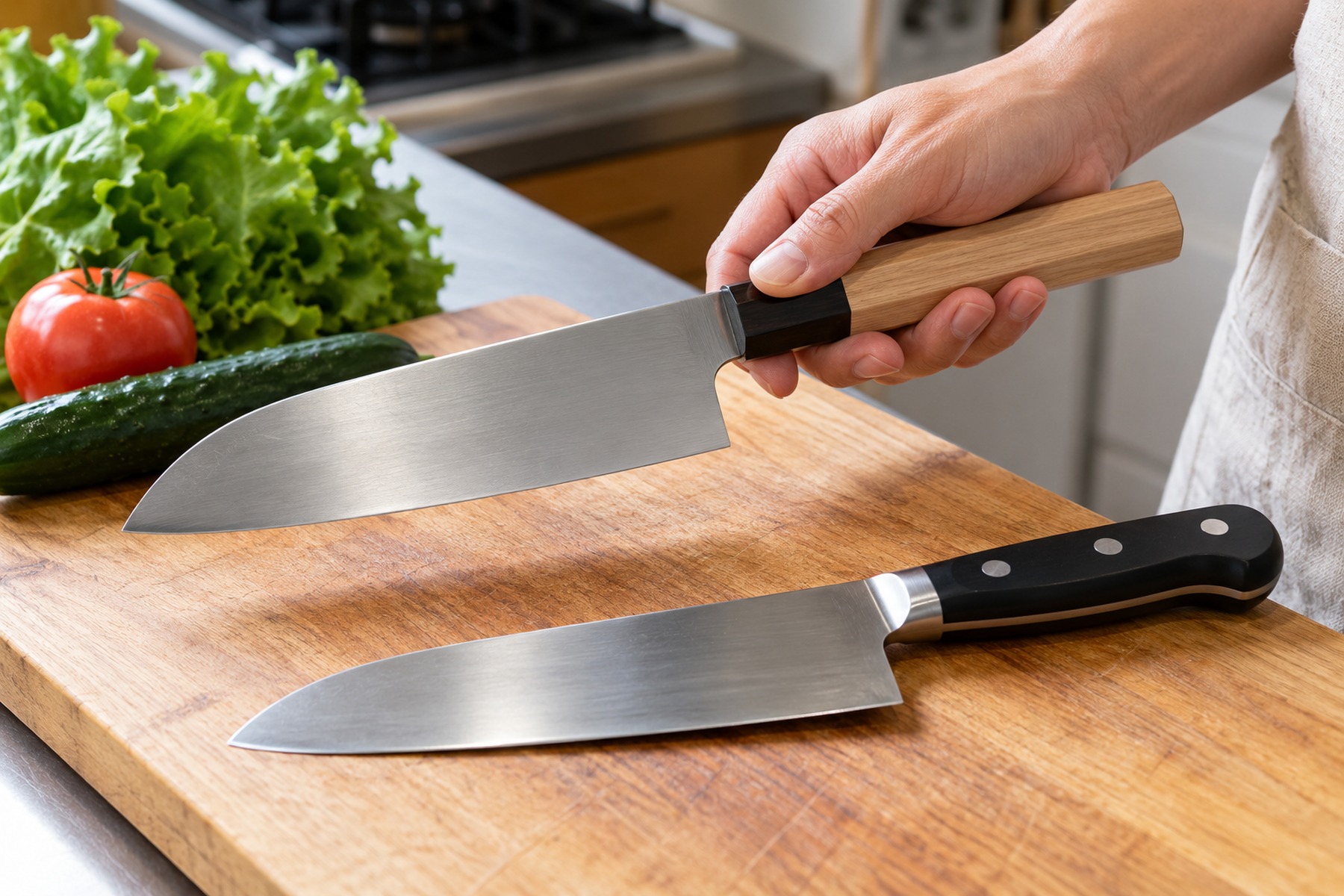
A santoku around 165–180 mm is the normal all-purpose range for many home kitchens. Shorter blades are easier to maneuver and store; longer blades give you more draw length for cabbage, squash and larger proteins. Match the knife to your board before chasing a specification.
Handle shape changes the experience as much as steel. Pakkawood Western handles feel familiar and give clear indexing. Octagonal Japanese-style handles can feel lighter and more neutral. All-stainless handles simplify material care but may feel different when wet, so texture and grip matter.
Steel names are useful only when paired with geometry and maintenance. VG10 and FC61 are stainless steels designed for kitchen cutlery, but heat treatment, grind and edge thickness still affect real cutting performance. A harder number on a product page does not make a knife automatically tougher; hard thin edges still dislike bones, frozen food and twisting.
- Short blade: easier control and storage
- Longer blade: more slicing length and board coverage
- Pakkawood: familiar feel, dry it promptly
- All stainless: simple material care, different grip feel
- Harder steel: potentially stronger edge retention, but still requires careful use
Overseas buyers should budget for landed cost and seller verification
A knife that costs less than $150 on the product page can exceed the budget after international shipping, tax, customs, brokerage or proxy fees. This is especially relevant to TOJIRO and Shun listings when you compare Japanese domestic pricing with U.S. retail.
Whenever possible, match the seller's model number to the maker's product page. Check blade length, steel, handle material and country of origin rather than relying on a generic marketplace title such as 'Japanese Damascus Santoku.' For a knife near the budget ceiling, a clear return policy can be more valuable than saving a few dollars.
If a model is only practical to buy from Japan, a proxy service can open access to domestic shops, but knives can face destination-specific carrier or import restrictions. Confirm whether the proxy will handle the item, whether your country permits the shipment, and what happens if the parcel is refused or returned.
- Compare model number against the maker page
- Add shipping, tax, customs and proxy fees before calling it under $150 delivered
- Check destination rules for kitchen knives before proxy ordering
- Keep the seller listing and purchase record for warranty or return questions
Care and sharpening determine whether a bargain stays a bargain
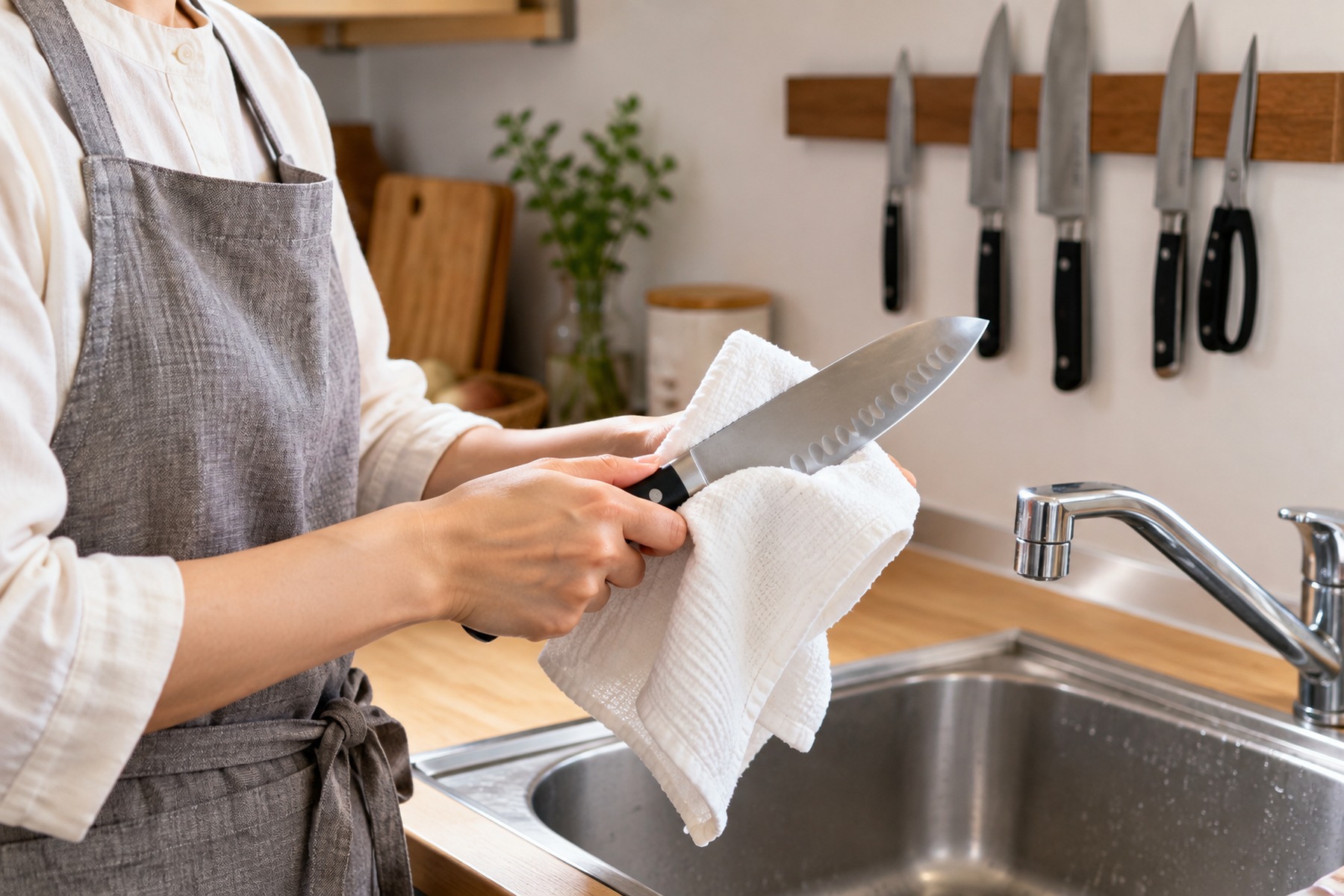
Every knife in this shortlist needs sensible daily care. Hand washing and immediate drying are the safest baseline unless the maker explicitly says otherwise. Do not leave a knife wet in a sink, store it loose against other metal tools, or use it on glass, stone or ceramic boards.
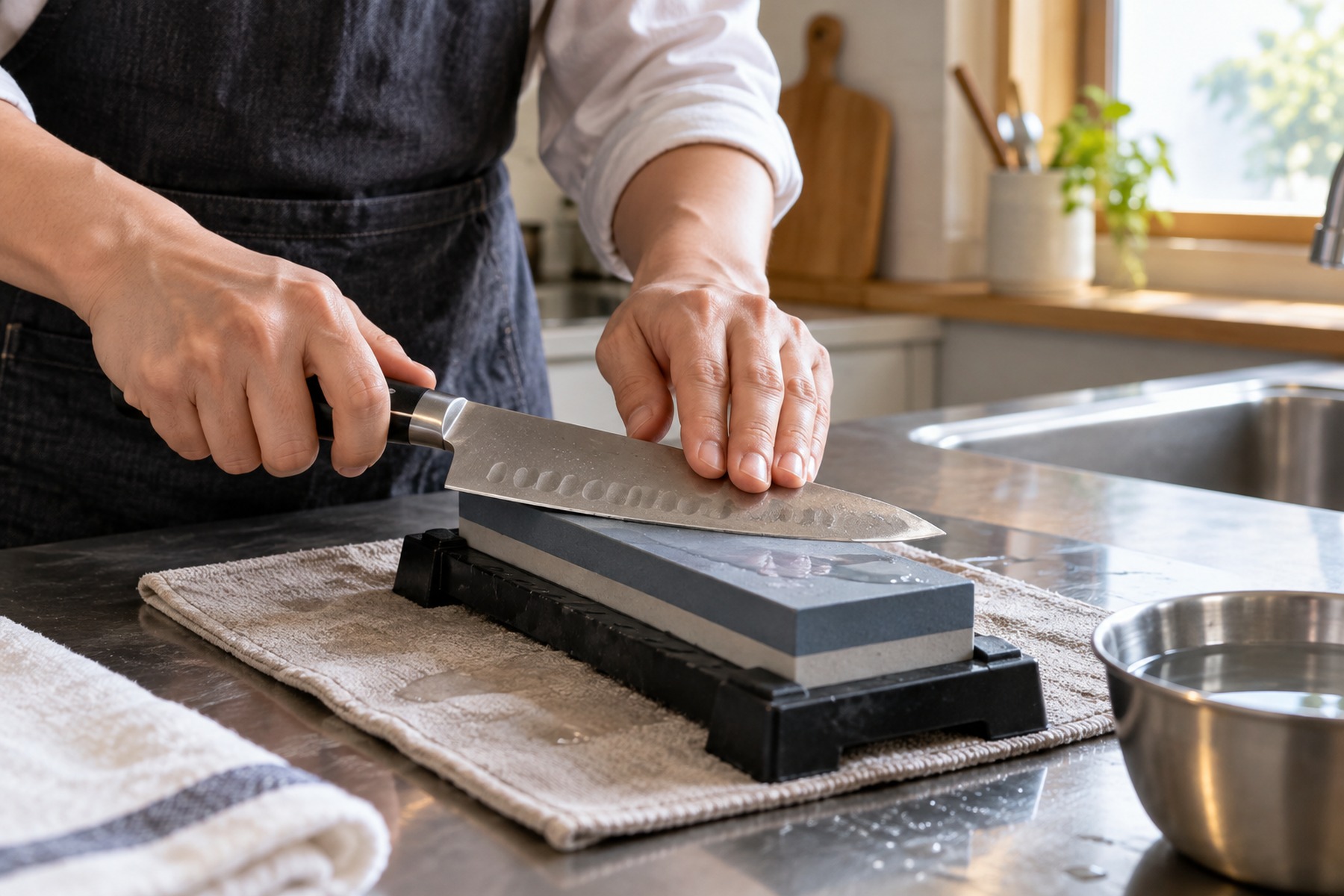
A medium-grit whetstone is a practical maintenance tool for double-bevel santoku knives, but sharpening angle and technique should follow the maker's guidance for the exact model. If you do not want to learn whetstone sharpening, check whether the brand offers a compatible sharpener or professional service before buying.
The most expensive mistake is not choosing the 'wrong' steel. It is buying a thin sharp knife and then using it on bones, frozen food or hard twisting cuts. Use a santoku for vegetables, boneless proteins and general prep, and use a heavier specialized tool for tasks that require impact or prying.
- Wash soon after use and dry completely
- Use wood or appropriate synthetic cutting boards
- Protect the edge in a block, sheath, drawer insert or suitable magnetic rack
- Sharpen before the knife becomes severely dull
- Do not use a santoku as a cleaver, pry bar or frozen-food knife
FAQ
- What is the best santoku under $150 for a first Japanese knife?
- For the lowest-friction first purchase, the MAC Superior SK-65 and TOJIRO BASIC F-316 are both strong fits. MAC is light and thin, while the TOJIRO gives you a 170 mm VG10 blade at a very low official Japan price. Choose by handle feel, blade length and where you can buy with a clear return policy.
- Is VG10 better than FC61?
- Not in every kitchen. Both are stainless cutlery steels used in reputable Japanese knives. The finished knife's heat treatment, grind, edge geometry, thickness and your sharpening habits matter as much as the steel label. Choose the complete knife rather than the alloy name alone.
- Is a 6-inch santoku too small?
- Not if you use a small cutting board or prefer compact control. A 6-inch santoku can handle most vegetables and boneless proteins, but a 170–180 mm blade gives more slicing length for large cabbage, squash and bigger prep jobs.
- Do hollow-ground dimples stop food from sticking?
- They can reduce the blade surface touching food and sometimes improve release, but they do not make a santoku non-stick. Wet potato, squash and other foods can still cling depending on blade geometry and technique.
- Can I buy a Japanese santoku directly from Japan and still stay under $150?
- Often the knife price is below the threshold, but the delivered total may not be. Add exchange-rate movement, shipping, tax, customs and any proxy fee, and check whether the carrier and destination permit kitchen-knife shipments before ordering.
Official References
Final Thoughts
A $150 ceiling is high enough to buy a serious Japanese santoku without paying for decorative features you may not need. Start with blade length and handle feel, then choose the maintenance level you will actually follow. MAC is the easy lightweight choice, TOJIRO BASIC and PRO cover two very different value profiles, Shun Sora adds length and hollow-ground geometry, and MIYABI KOH brings a compact premium feel near the top of the budget. Recheck the live price and seller before checkout, especially when buying from Japan, because the delivered cost—not the product page alone—is what ultimately determines whether the knife stays inside your budget.