Watoria Guide
How to Buy Japanese Trading Cards from Japan Safely
A practical guide to buying Japanese trading cards safely: verify the exact release, judge seller evidence and condition, reduce counterfeit and searched-pack risk, and protect cards during international shipping.
- Quick Answer
- What You’ll Learn
- 1. Decide What You Are Actually Buying
- 2. Verify the Exact Japanese Release Before You Pay
- 3. Judge the Seller Before You Judge the Card
- 4. Inspect Authenticity as a Pattern, Not a Single Trick
- 5. Grade Condition Conservatively
- 6. Treat Sealed Product and Mystery Packs as Different Risks
- 7. Choose a Buying Route That Matches Your Risk Tolerance
- 8. Protect the Card Before It Leaves Japan
- 9. Plan International Shipping, Customs and Returns
- 10. A Practical Pre-Purchase Checklist
- FAQ
- Related Guides
- Official References
- Final Thoughts
- Keep exploring Japanese culture
- Continue to the best buying / booking route
- Continue exploring
- Discover more Japan
- Primary sources
Quick Answer
Start by identifying the exact Japanese release you want, then verify it against the publisher’s official card or product database. Prefer sellers who show clear photos of the actual item, describe condition precisely, and have a credible transaction history. Treat unusually vague sealed listings, “high-hit” mystery packs, searched packs, and replica-style products as high risk. For valuable singles, ask for front, back, corners, edges, surface and set-number photos before paying, and use protective international shipping with the item declared as merchandise when required.
What You’ll Learn
- How to verify the exact Japanese card, set and product before buying
- How to judge seller evidence, listing quality and condition
- How to reduce counterfeit, replica and searched-pack risk
- How sealed products, singles and mixed lots differ in risk
- How to protect cards during storage, packing and international shipping
1. Decide What You Are Actually Buying
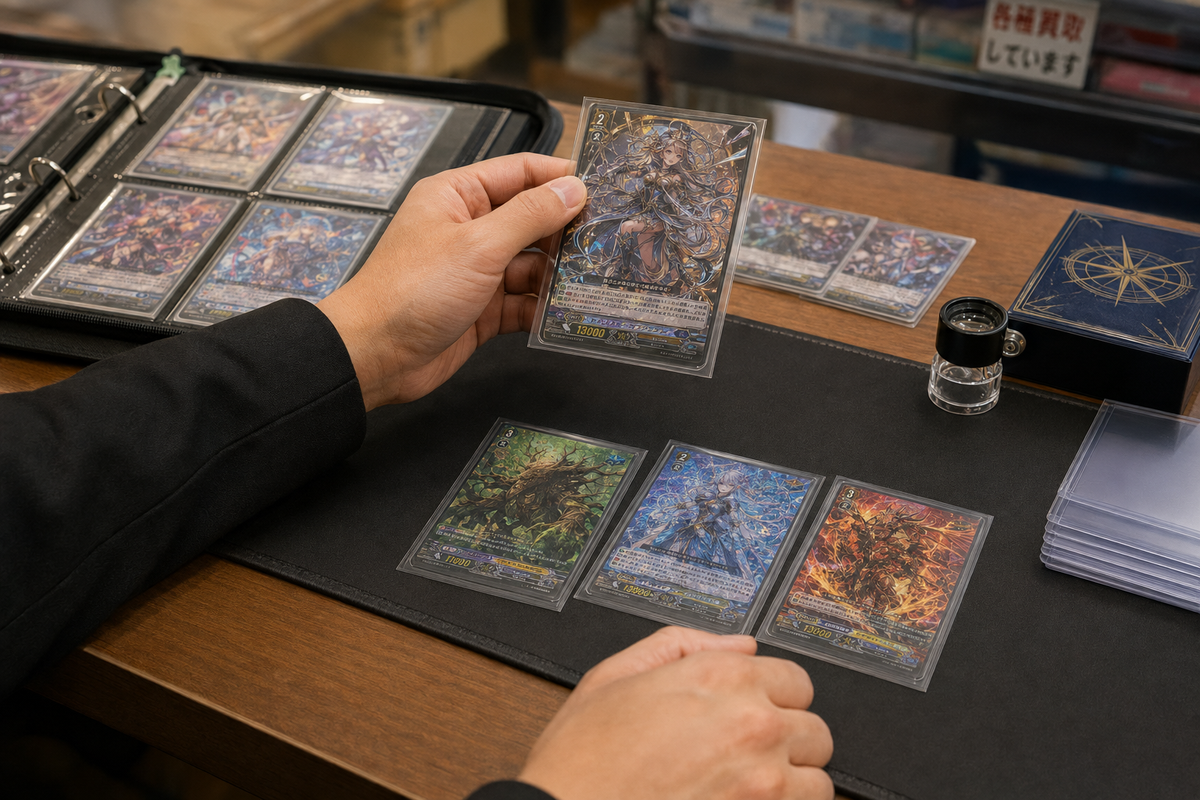
Japanese trading-card listings can describe very different products: factory-sealed boxes, loose booster packs, individual singles, complete or partial sets, promotional cards, graded cards, and mixed lots. The safest buying process starts by defining the exact format you want, because the evidence you should demand is different for each one.
Sealed product reduces the need to grade each card in advance, but it adds packaging and tampering risk. Singles let you target the exact card and condition, but require stronger photo evidence. Mixed lots can be efficient for low-value collecting, yet they are the hardest format to audit card by card.
- Sealed box: verify product name, release, seals and package condition.
- Loose pack: treat provenance and tampering risk more cautiously than a sealed box.
- Single card: verify exact card number, rarity/finish, language, condition and authenticity.
- Lot or collection: confirm whether photos show every included card or only representative examples.
2. Verify the Exact Japanese Release Before You Pay
Do not rely on a marketplace title alone. Search the publisher’s official Japanese card database or product information and match the card name, artwork, card number, rarity or finish, and the product or set in which it appeared. Pokémon’s official Japanese site provides a card search, while Konami’s official OCG database lets collectors search cards and see the products or packs in which they are included.
This step also prevents a common collecting mistake: assuming a Japanese card is identical to an overseas release. Language, set numbering, product configuration, release timing and tournament compatibility can differ by game and region. If play legality matters, verify the rules for the region where you intend to use the card.
- Match the visible card number and artwork to an official database.
- Confirm whether the listing is Japanese-language OCG/Japanese-market product or an overseas TCG release.
- Check the official product or pack list when the seller claims a specific origin.
- Save the official reference before buying high-value cards so you can compare listing photos carefully.
3. Judge the Seller Before You Judge the Card
A convincing card photo does not automatically make the transaction safe. Evaluate the seller’s history, whether they specialize in collectibles, how consistently they describe condition, and whether their photos appear to show the actual item. A listing with original, well-lit photos and specific condition notes is easier to audit than one built from stock images and generic claims.
For expensive singles, ask questions before paying. A reliable seller should be able to clarify whether the card has dents, whitening, scratches, print lines, warping, clouding, pressure marks or other defects that may not be obvious in a single front-facing photo.
- Prefer actual-item photos over catalog or stock images for valuable singles.
- Check whether condition terms are supported by close-up evidence.
- Read recent feedback for packaging, item accuracy and dispute handling—not only the percentage score.
- Be cautious when a seller refuses reasonable requests for additional photos of a high-value card.
4. Inspect Authenticity as a Pattern, Not a Single Trick
There is no universal one-step counterfeit test that works for every Japanese trading-card game, era and rarity. Counterfeiters can imitate individual features, so use several independent checks together: official card data, correct layout and numbering, print quality, expected finish, card stock behavior, seller provenance and comparison with known genuine examples.
The Pokémon Card Game’s official Japanese site has specifically warned consumers about unauthorized counterfeit and replica-style goods sold through online marketplaces. That is a strong reason to treat phrases such as “replica,” unofficial metal cards, or listings that avoid showing normal card details as red flags rather than bargains.
- Cross-check the card against the publisher’s official database.
- Compare borders, symbols, numbering, artwork crop and finish with verified examples.
- Look for inconsistent fonts, muddy printing, incorrect foil behavior or suspicious card stock.
- For expensive purchases, favor provenance and seller evidence over one visual “tell.”
5. Grade Condition Conservatively
Condition language is not perfectly standardized across Japanese shops and marketplaces. One seller’s “good” can be another seller’s “played,” and a card described as “near mint” can still show factory print lines or tiny edge marks. Treat the photos and written defect notes as the real evidence, not the label alone.
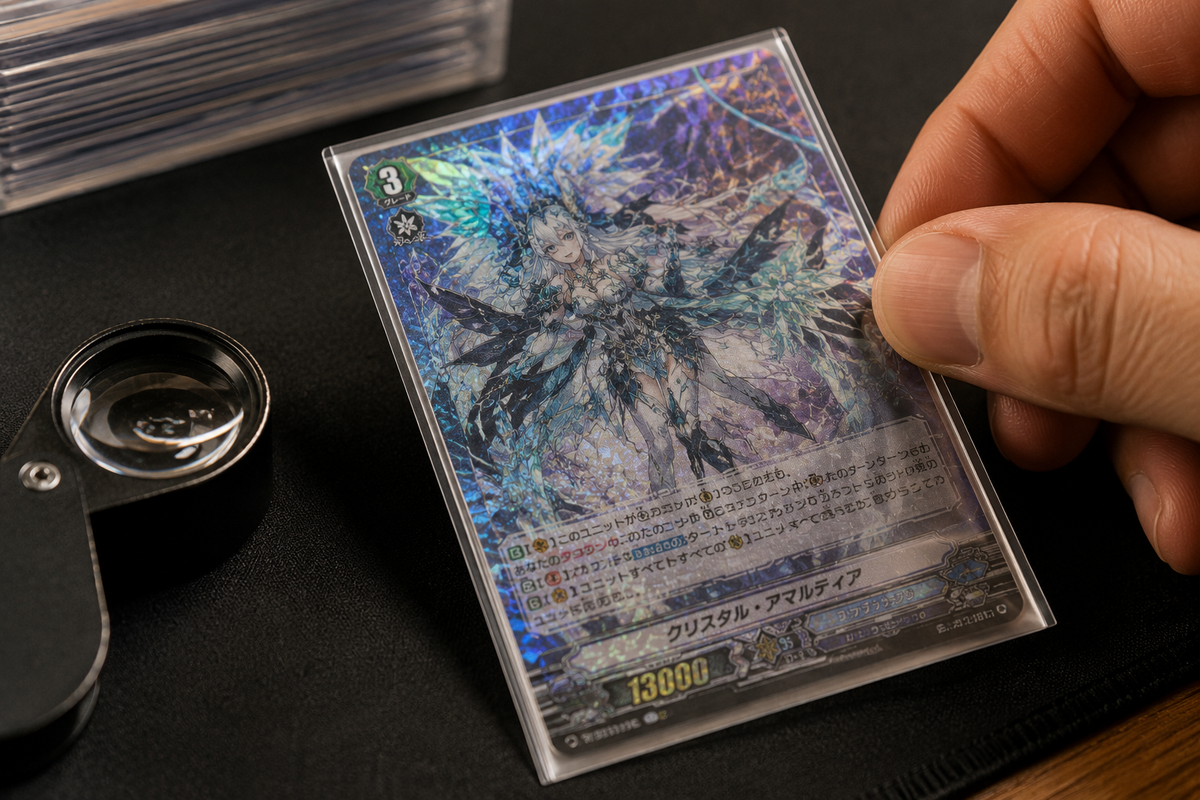
For collectible singles, examine the front and back under angled light. Check all four corners, each edge, the foil or gloss surface, centering if it matters to you, and any dents or impressions. If grading is part of your plan, buy based on the card you can actually see—not on an assumed future grade.
- Front surface: scratches, print lines, dents, clouding and foil damage.
- Back surface: whitening, edge chips, scuffs and discoloration.
- Corners and edges: compression, bends, peeling or handling wear.
- Shape: warping, creases and pressure marks that may only appear under raking light.
6. Treat Sealed Product and Mystery Packs as Different Risks
A sealed-looking item is not automatically factory-original or untampered. For sealed boxes, compare the package design and expected seals with official product information and reputable-store photos. For loose booster packs, provenance matters more because the original box context is gone.
Pokémon’s Japanese official site has warned buyers about counterfeit products, original “oripa” mystery packs advertised with high-hit claims, and searched packs or boxes from which desirable packs may have been removed. These warnings are specific to Pokémon listings, but the general risk-management lesson is broader: do not treat a seller-created random product as equivalent to a factory-sealed publisher product.
- Separate factory-sealed publisher products from seller-created mystery products.
- Be skeptical of vague “high probability,” “guaranteed hit” or similar claims without verifiable terms.
- For loose packs, price alone cannot prove they are unsearched or untampered.
- When authenticity matters most, prefer a reputable specialist source with clear return rules.
7. Choose a Buying Route That Matches Your Risk Tolerance
There is no single best route for every collector. Official or authorized retail channels generally reduce product-authenticity risk, but stock and overseas delivery may be limited. Established card shops often provide clearer condition grades and stronger collectible expertise. Marketplaces provide the widest selection but shift more verification work to the buyer.
Proxy or forwarding services can help overseas buyers access Japanese domestic shops and marketplaces, but they add another layer between buyer and seller. Before using one, understand inspection limits, prohibited items, consolidation rules, return handling, insurance and what happens if the domestic seller sends the wrong card.
- Official/authorized retail: strongest product-origin confidence, but limited releases or overseas access may apply.
- Specialist card shop: useful condition language and collectible expertise; compare each shop’s grading standard.
- Marketplace: widest supply and price range, but seller-level due diligence becomes critical.
- Proxy/forwarder: useful access tool, but check inspection, return and compensation limits before purchase.
8. Protect the Card Before It Leaves Japan
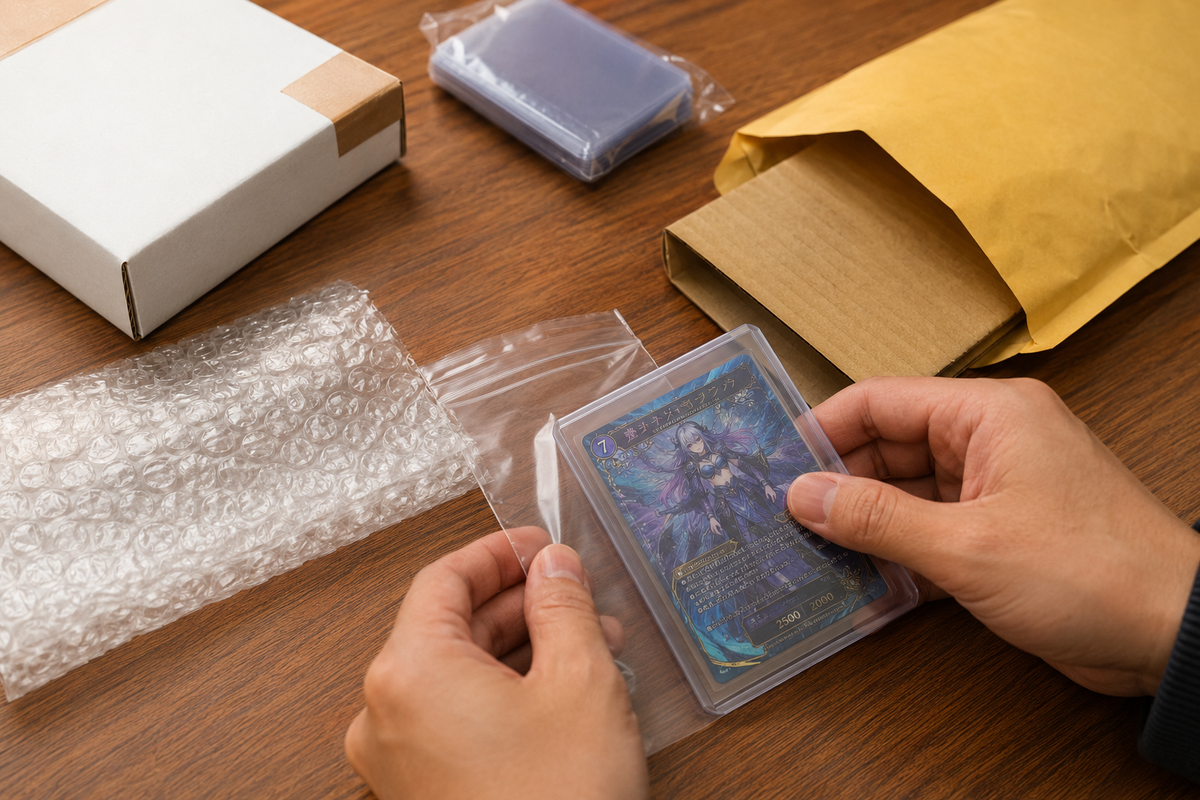
Shipping damage can erase the value of a careful purchase. Valuable singles should normally be immobilized so the card cannot slide, bend or contact adhesive. A common protective approach is an inner sleeve, a rigid holder or top loader, a resealable outer bag, and stiff cardboard protection inside a padded or rigid mailer.
For sealed product, crush protection and moisture resistance matter more than card-level sleeves. Ask how the seller or forwarding service packs collectibles, especially for expensive boxes, graded slabs or combined shipments.
- Keep adhesive tape away from the exposed card and sleeve opening.
- Prevent movement inside rigid holders and mailers.
- Use moisture protection for long international routes.
- For graded cards, protect both the slab surface and the slab’s corners.
9. Plan International Shipping, Customs and Returns
A trading card bought as merchandise should be treated as merchandise in international shipping documentation. Japan Post explicitly states that game cards with commercial value cannot be sent as “documents” and that an appropriate non-document item category should be selected for EMS or other international mail when the cards are goods for sale.
Import duties, taxes, carrier fees and customs procedures depend on the destination country and declared value. Before buying, compare the seller’s return window with realistic international transit times, and understand whether a return must go back to the original Japanese seller or through a proxy service.
- Use tracked shipping for cards whose loss would be difficult to absorb.
- Check compensation limits against the actual purchase value.
- Declare merchandise accurately; do not ask a seller to misdescribe the contents.
- Keep order records, listing screenshots and packing photos until the transaction is fully resolved.
10. A Practical Pre-Purchase Checklist
A safe purchase is usually the result of several ordinary checks done consistently. Before you pay, make sure you can explain exactly what the item is, why you believe it is genuine, what condition you expect, who is responsible if the listing is wrong, and how the item will be protected in transit.
If any of those answers depend on guesswork, pause the purchase and collect more evidence. Walking away from an unclear listing is often cheaper than trying to solve an authenticity or condition dispute across borders.
- Exact Japanese card/set/product verified from an official source.
- Actual-item photos reviewed at useful resolution.
- Seller history and condition description checked.
- Counterfeit, searched-pack and mystery-product risks considered.
- Packing, tracking, insurance and customs method understood.
- Return/dispute route understood before payment.
FAQ
- Are Japanese trading cards always cheaper in Japan?
- No. Domestic supply can make some items easier to find, but collectible prices change by card, condition, release and demand. Shipping, proxy fees, taxes and currency conversion can erase an apparent price advantage. Compare the total landed cost rather than the listing price alone.
- How can I tell whether a Japanese trading card is fake?
- Use several checks together: verify the exact card in the publisher’s official database, compare artwork and numbering, inspect print and finish, review seller provenance and request clear photos. Do not rely on one universal “fake card test,” because materials and finishes vary across games and eras.
- Is it safer to buy a sealed box than loose booster packs?
- A genuine factory-sealed box usually gives you more packaging context than loose packs, but it can still be counterfeit or tampered with. Loose packs require more trust in the seller’s provenance. Compare seals and packaging with official product information and buy from a source whose reputation and return policy you understand.
- What photos should I request for an expensive single card?
- Ask for the full front and back, all four corners, both long edges, both short edges, and angled-light photos of the surface. If the card has a special foil or texture, request a short angle change or multiple photos that show how the finish behaves.
- Should Japanese cards be shipped as documents?
- When cards are merchandise with commercial value, Japan Post says they cannot be sent as documents and an appropriate non-document item category should be used for EMS or other international mail. Shipping rules and customs requirements can also vary by destination.
- Do I need a proxy service to buy from Japan?
- Not always. Some Japanese retailers ship internationally or sell through global storefronts. A proxy can expand access to domestic-only shops and marketplaces, but you should understand its inspection, return, consolidation, insurance and compensation rules before using it.
Official References
Final Thoughts
The safest way to buy Japanese trading cards is to reduce uncertainty before money changes hands. Verify the exact release from an official source, judge the seller and the actual item separately, treat sealed and mystery products according to their real risks, and make shipping protection part of the purchase decision. A clear listing from a reliable source at a fair total cost is usually a better collectible purchase than a cheaper listing that forces you to guess.